


How does an Australian tax resident pay tax in Australia?
Here’s how tax works for Australian tax residents depending on what you earn during the financial year, if you meet the requirements to be taxed as a resident.
10-second summary
If you only want the essentials, here you go. Below you’ll find the full explanation and the table.
People on visas other than Work & Holiday (Student, Sponsor, Skilled, Partner, etc.) or Permanent Residents.
If you earn less than $18,200 in the financial year, the tax you paid is typically refunded (income under the threshold is tax-free).
From $18,200 to $45,000 you pay 16%. Above $45,000: $4,288 + 30% of the amount over $45,000.
Am I an Australian resident for tax purposes?
If you’ve been working legally in Australia on a visa or work permit, the first question you should ask yourself is: Am I an Australian resident for tax purposes?
To answer that, you’ll usually need to consider a few key points:
- You have lived in Australia long-term, or you arrived later but have been granted a Permanent Resident visa.
- You came to Australia—or while you were here, you were granted a visa other than a Work and Holiday. This includes the COVID visa and Bridging visas obtained after a W&H visa.
- Student
- Postgraduate
- Sponsor
- Skilled
- Partner (linked to someone who is a tax resident)
Confirming your status (tax resident) is essential to apply the right tax brackets and avoid surprises when lodging your Tax Return.
What tax do I have to pay?
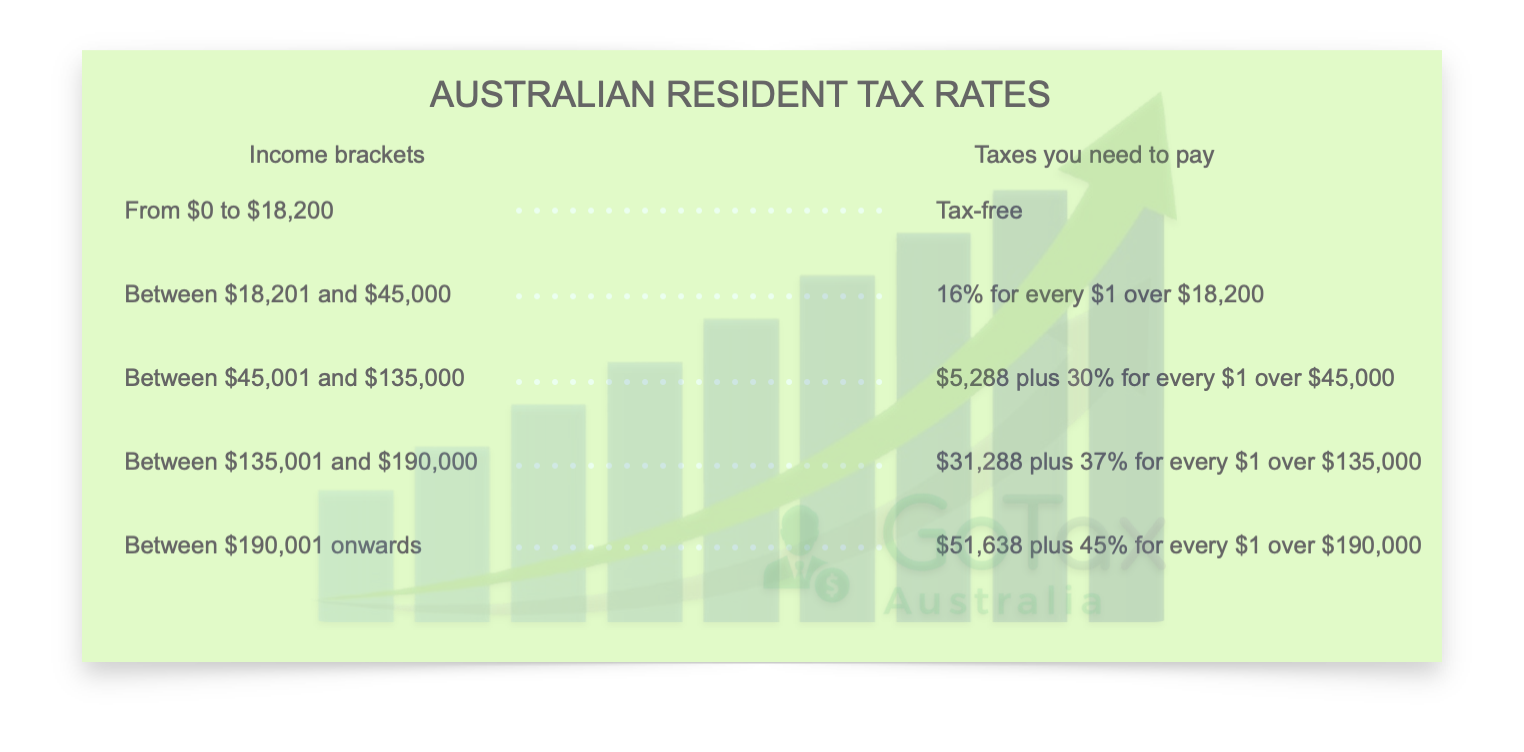
Income brackets and tax rates
As you can see in the table, if you’re taxed as a resident and you earn less than $18,200 during the financial year, any tax you paid is typically refunded, because income up to that amount is tax-free.
Once you go over that threshold, you start paying 16% on every dollar above $18,200, up to $45,000.
After you pass the second threshold, you’ll pay the tax from the previous bracket ($4,288) plus 30% of every dollar above $45,000, and so on for each bracket shown in the table below.
The next step is understanding how your tax is calculated, which depends on how much you earn throughout the financial year.
Tip
If you’re an Australian resident for tax purposes, you need to understand how your tax obligations work—because they vary by income bracket. Make sure you meet the residency criteria and apply the right rates. That way, you’ll avoid unexpected debts when lodging your Tax Return.
If you have any questions, feel free to contact us.